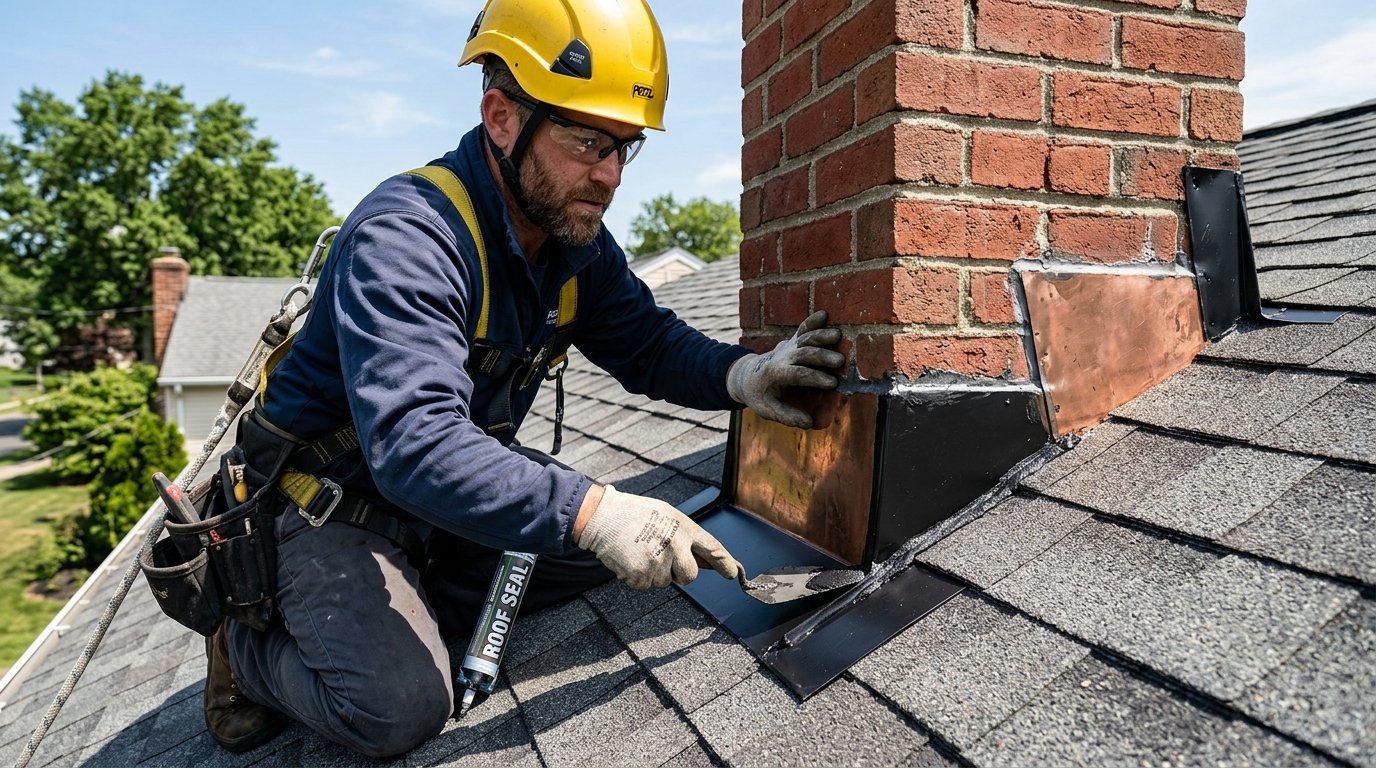
Why Roof Flashing Fails Before the Shingles
When Bridgewater homeowners discover water staining a drywall ceiling or dripping into the attic, the instinct is often to assume their asphalt shingles have worn out. However, our field inspections reveal that over 80% of residential roof leaks originate from compromised metal flashing, not the field shingles.
While fiberglass architectural shingles can endure 25 to 30 years under New Jersey weather, the transitions—where the roof meets a brick chimney, dormer sidewall, plumbing vent, or valley—expand and contract at vastly different rates than wood decking. Over years of thermal cycling, sealants dry out, nails back out, and thin aluminum corrodes, opening an unhindered channel for rainwater to enter the roof deck.
Chimney Step & Counter Flashing: The Gold Standard Repair
Chimneys are the single most common leak source in older Bridgewater neighborhoods like Finderne and Bradley Gardens. Brick masonry is porous and absorbs moisture. To protect the roof intersection, two independent flashing components must work in unison:
- Step Flashing (L-shaped metal pieces): Bent at 90 degrees, woven under every individual shingle course, and placed up against the chimney brickwork.
- Counter-Flashing (Cap Flashing): Embedded directly into a mortar joint (a mechanical reglet cut) and folded down over the vertical lip of the step flashing.
Why Tar & Caulk Fail
Unqualified handymen often smear black roofing cement over rusted flashing. In New Jersey, summer roof temperatures exceed 140°F while winter nights drop below 15°F. Tar becomes brittle, shrinks, and cracks within 6 months, trapping moisture directly against the brick and rotting the surrounding wood deck.
Valleys & Plumbing Pipe Collar Boots
Valley Intersections: Where two sloping roof planes meet, rainwater channels at heavy volume and velocity. Standard closed-cut valleys can trap pine needles and ice dams. Replacing degraded valley flashing with 26-gauge pre-bent W-valley metal over ice-and-water shield creates a lifetime waterproof flume.
Plumbing Vent Pipe Boots: Neoprene rubber collars dry rot from intense UV radiation within 8 to 12 years. Once the rubber splits, rainwater trickles down the PVC pipe directly into bathroom ceilings. We replace split boots with heavy-duty silicone or lead pipe boots that outlast the shingle system.
Mechanical Exhaust & Dryer Roof Caps: Bathroom exhaust fans, furnace flues, and dryer roof caps are frequent sources of driving rain infiltration. If an exhaust run vibrates or backs up warm moist air into the attic, arranging timely appliance repair and duct diagnostics ensures exhaust lines remain clear while your roofing technician reseals exterior damper hoods against weather intrusion.
How Hidden Flashing Leaks Rot Structural Rafters
When a flashing leak goes undetected for months, water travels silently along the top edges of 2x6 or 2x8 roof rafters before accumulating enough volume to drip through ceiling drywall. Over time, wood-decay fungi feast on the damp lumber, causing:
- Softened, spongy roof decking (OSB or plywood delamination).
- Rafter deflection (a visible dip or sag on your roof slope).
- Mildew, dry rot, and degraded attic insulation R-value.
How Master Roofers Repair Rafters: The "Sistering" Technique
Repairing a rotted rafter does not require tearing off your entire roof structure. Master roofing carpenters utilize structural lumber sistering:
- Expose the Structural Frame: Remove shingles and rotted plywood decking over the affected framing bay.
- Excavate Decay: Treat sound existing timber with wood preservative and remove fully decayed material.
- Sister New Dimensional Lumber: Sandwich a full-length, pressure-treated 2x6 or 2x8 rafter alongside the existing member, secured with structural framing screws and staggered bolting according to NJ UCC building code.
- Install New CDX Plywood: Nail fresh 5/8-inch exterior-grade plywood sheathing flush with the existing plane.
- Apply High-Temp Ice & Water Shield: Seal the entire repaired deck zone before shingling and mechanically flashing the penetration.
Frequently Asked Questions
How much does roof flashing repair cost in Bridgewater, NJ? +
Targeted flashing repairs typically range from $350 for a plumbing pipe boot replacement to $850–$1,600 for comprehensive chimney step and counter-flashing replacement, saving thousands compared to unnecessary whole-roof replacements.
How long does a flashing or rafter sistering repair take? +
Most specialized flashing and rafter sistering repairs are completed in a single morning or afternoon (3 to 6 hours), ensuring your home is watertight before evening weather.
Do you provide emergency flashing leak dispatch in Somerset County? +
Yes. Bridgewater Roofer provides 24/7 emergency dispatch across Bridgewater, Basking Ridge, Somerville, Raritan, and Warren. Call (908) 465-9944 for immediate service.