Key Takeaways for Homeowners
- Yes, Permits Are Mandatory: Bridgewater Township Code Enforcement requires a building permit for all full roof replacements, re-roofs, and major structural decking repairs.
- Minor Repairs Exemption: Patching minor leaks or replacing a small cluster of storm-damaged shingles (under 25% of the roof plane) is classified as ordinary maintenance and does not require a permit.
- Two-Layer Maximum: New Jersey UCC Chapter 15 prohibits installing more than two layers of shingles. If two layers already exist, the roof must be stripped to the bare decking.
- Ice Barrier Mandate: Code requires self-adhering polymer modified bitumen ice barrier installed along all eaves to at least 24 inches inside the interior heated wall plane.
- Contractor Licensing: By NJ law, only New Jersey Division of Consumer Affairs registered Home Improvement Contractors (HIC) carrying active general liability insurance can pull permits on your behalf.
Bridgewater Permit Requirements: When Is a Permit Needed?
Under the New Jersey Uniform Construction Code (N.J.A.C. 5:23) and the International Residential Code (IRC NJ Edition), residential roofing work is classified under specific tiers of municipal oversight:
Permit Required:
-
Complete tear-off and replacement of asphalt shingles, metal panels, or flat membrane systems.
-
Installation of a second overlay layer over an existing single shingle layer.
-
Structural decking replacement exceeding 25% of the total roof surface or rafter structural modifications.
Permit NOT Required (Ordinary Maintenance): Minor spot repairs replacing individual damaged shingles, resealing loose flashing around a vent pipe, or re-caulking gutters generally qualify as ordinary maintenance under N.J.A.C. 5:23-2.7 and do not require municipal permits.
Permit Application Process & Required Municipal Forms
Applying for a roofing permit in Bridgewater involves submitting specific standard state construction forms to the Construction Official at 100 Commons Way:
| Form Name | Form Number | Purpose & Description |
|---|---|---|
| Construction Permit Application | UCC Form F100 | Identifies property owner, block/lot coordinates, general contractor info, and cost valuation. |
| Building Subcode Technical Section | UCC Form F110 | Specifies roofing square footage, shingle brand/weight, ice barrier placement, and ventilation specs. |
| Contractor License & Insurance | NJ HIC Verification | Copy of active NJ Home Improvement Contractor license and certificate of general liability insurance. |
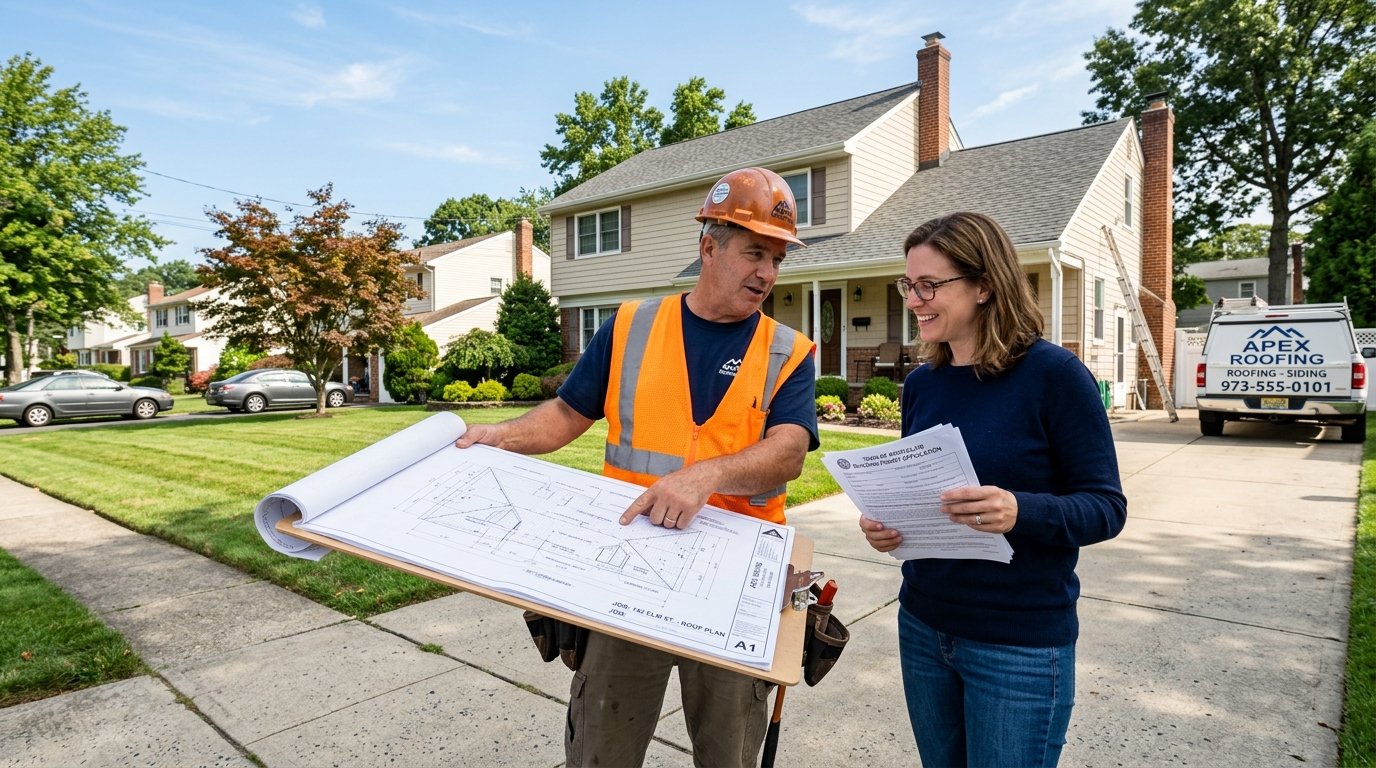
Hassle-Free Permitting & Guaranteed Compliance
We manage all township filings, plans, and inspections so you never have to deal with municipal bureaucracy.
Key NJ UCC Roofing Codes Every Homeowner Must Know
Inspectors in Somerset County evaluate every replacement against strict performance standards:
1. Section R905.1.2 — Ice Barrier Requirement: In areas with a history of ice damming (all of Somerset County), an ice barrier consisting of at least two layers of underlayment cemented together or a self-adhering polymer-modified bitumen sheet must be installed from the eave's edge to a point at least 24 inches inside the exterior wall line.
2. Section R905.2.8.5 — Drip Edge Installation: Drip edge metal must be provided at eaves and gables of shingle roofs. The drip edge must overlap the underlayment by at least 2 inches at eaves and extend down the fascia board by at least 1/4 inch.
3. Section R806.1 — Attic Ventilation Ratios: The code mandates minimum net free ventilating area of 1/150 of the attic floor space, or 1/300 when balanced between ridge exhaust and soffit intake. Failure to maintain balanced airflow voids shingle manufacturer warranties.
Municipal Inspection Steps: What the Inspector Checks
Once your roof replacement is finished, Bridgewater Township Code Enforcement conducts a required final inspection before issuing a Certificate of Approval:
-
Flashing & Counter-Flashing: Verification that chimney counter-flashing is mortared or sealed and wall step-flashing is properly seated beneath siding.
-
Ventilation & Exhaust Integrity: Ensuring that bathroom vent ducts and furnace flues remain securely connected and exhaust freely outside.
-
Ground Cleanup & Nail Sweeping: Confirmation that job debris, old shingles, and stray nails have been fully cleared from walkways, driveways, and lawns.
Contractor vs. Homeowner Responsibilities
If a contractor asks you to pull the permit as a "homeowner doing your own work," decline immediately. Contractors who make this request often lack an active NJ Home Improvement Contractor license, carry insufficient workers' compensation insurance, or are attempting to dodge state liability laws.
When Bridgewater Roofer handles your project, we pull all permits under our corporate license (#13VH09876500) and take 100% legal responsibility for meeting all building codes and inspection standards.
Frequently Asked Questions
In Bridgewater Township, roofing permit fees are calculated based on the estimated valuation of the project. A typical residential roof replacement permit fee ranges between $175 and $325. Bridgewater Roofer includes permit preparation and municipal filing fees directly in our contracts.
The Bridgewater Township Code Enforcement & Construction Department is located in the Bridgewater Municipal Complex at 100 Commons Way, Bridgewater, NJ 08807. Office hours are Monday through Friday, 9:00 AM to 5:00 PM.
Replacing a roof without a required permit violates the New Jersey Uniform Construction Code. The township inspector can issue a Stop Work Order, levy fines of up to $2,000 per violation, and require shingles to be torn off to inspect the underlying decking and ice barrier. It also creates major title closing hurdles during home resale.
Yes. All municipalities in New Jersey operate under the NJ UCC. Towns including Somerville, Raritan, Basking Ridge (Bernards Township), Bedminster, Branchburg, Hillsborough, and Warren mandate permits for complete roof replacements.
Yes, 100%. As a licensed NJ Home Improvement Contractor (#13VH09876500), Bridgewater Roofer prepares all technical UCC subcode forms, submits plans, pays initial municipal fees, coordinates on-site inspections, and delivers your final Certificate of Approval.