Key Takeaways for Homeowners
- The 50% Rule: If the cost of repairing your roof exceeds 50% of the cost of a full replacement, replacement provides far better long-term equity and warranty protection.
- Age Thresholds: If your architectural asphalt shingles are over 18 to 20 years old in Central New Jersey, repairing individual leaks provides diminishing returns as whole-deck brittle failure begins.
- Structural Plywood Integrity: Localized shingle blow-offs can be patched in an afternoon, but spongy decking, rotting rafters, or widespread moisture staining in the attic demand a complete tear-off.
- NJ UCC Code Limits: The New Jersey Uniform Construction Code prohibits installing a third layer of shingles. If your home already has two layers, any major work mandates a complete tear-off to the bare wood.
- Cost Contrast: Average professional leak repair in Somerset County ranges from $350 to $1,250, whereas a complete architectural shingle roof replacement averages $8,500 to $16,500 depending on home square footage and pitch.
The Core Decision Rules: Repair or Replace?
Every roofing inspection in Somerset County begins with three fundamental criteria: the age of the roofing system, the scope of the physical compromise, and the condition of the underlying roof decking.
Many homeowners assume that any ceiling water stain requires a massive $12,000 replacement. In reality, over 65% of active leaks stem from isolated flashing failures or dried plumbing boots that can be permanently resolved with professional repairs. However, investing $1,500 into patching a 22-year-old dried asphalt roof is equivalent to throwing good money after bad.
Take the estimated cost of repairs and multiply it by the remaining estimated years of roof life. If the total exceeds 50% of the cost of a full replacement, replacement is mathematically the superior investment that preserves home equity.
When Roof Repair Is the Smarter Choice
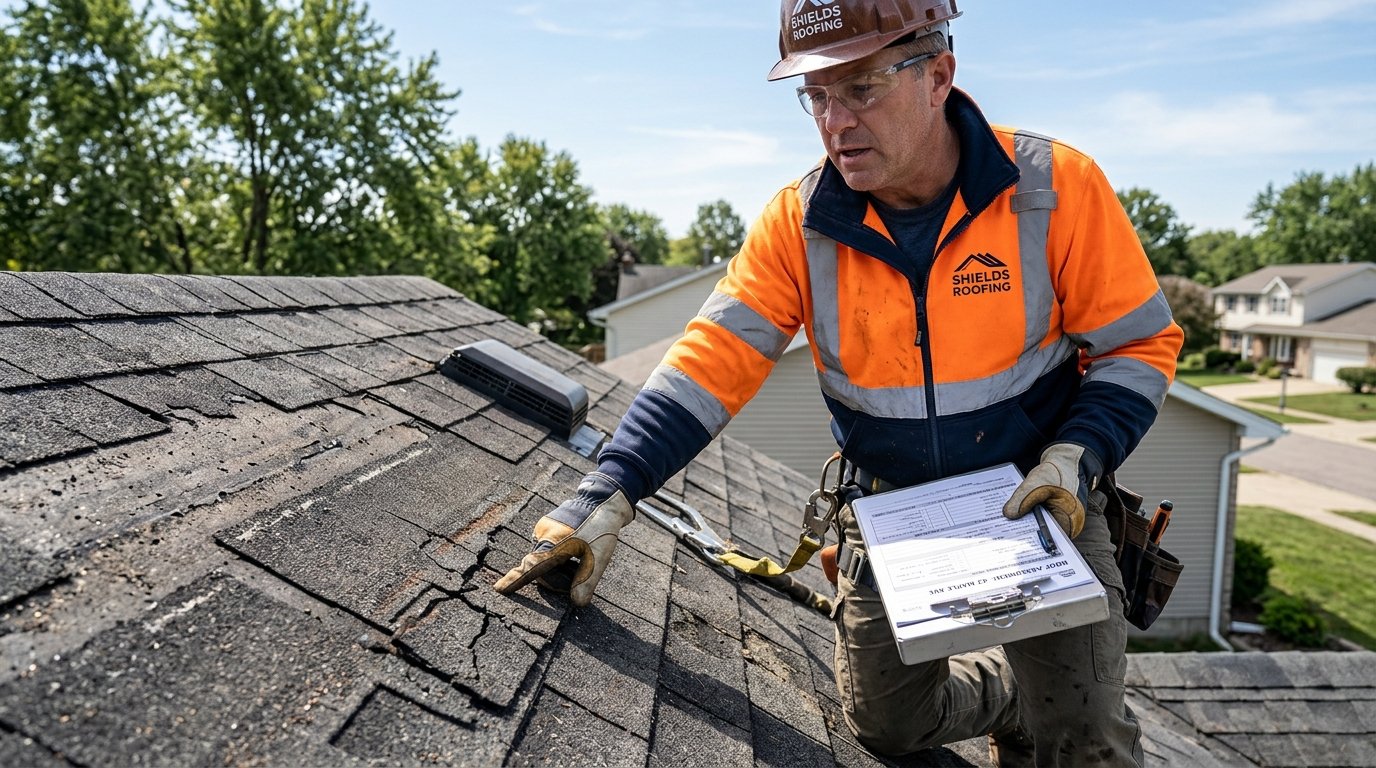
Targeted repairs are the ideal solution when the overall roofing membrane remains pliable, properly adhered, and within its structural prime. You should choose repair when:
-
The Roof Is Under 15 Years Old: Architectural dimensional shingles have ample asphalt oil reserves remaining, allowing technicians to lift courses without tearing adjacent materials.
-
The Leak Source Is Isolated: The failure is confined to a known penetration point such as a cracked plumbing vent boot, deteriorated chimney counter-flashing, or a missing cap shingle.
-
Minor Isolated Storm Damage: High winds dislodged 3 to 10 shingles, but the surrounding field shingles maintain strong adhesive seal strips and full granule coverage.
-
Plywood Decking Is Firm & Dry: Attic inspection confirms zero rafter sag, no delamination of CDX plywood, and zero black mold accumulation.
Need an Honest, Unbiased Assessment?
Our Bridgewater technicians never push for replacement if a high-grade repair will safely protect your home for years to come.
When Full Roof Replacement Is Mandatory
In contrast, attempting to patch a roof exhibiting systemic structural decay only prolongs the inevitable while exposing interior ceilings, insulation, and framing to catastrophic mold damage. Full replacement is essential when:
- Severe Granule Loss & Exposed Fiberglass: Gutters filled with coarse asphalt sediment and bare, shiny fiberglass backing visible on slopes.
- Curling, Cupping, or Clawing Shingles: Shingles curling upward at edges or bowing in the middle indicate dried, brittle asphalt binder failure.
- Multiple Chronic Leak Sites: Water penetrating through different bedrooms or eaves after every moderate nor'easter or thunderstorm.
- Spongy or Sagging Roof Planes: Soft spots when walking on the roof caused by rotted plywood decking or decayed structural rafters.
- Two Existing Shingle Layers: Homes already having two layers cannot be overlaid by law and must be completely stripped down.
Cost Comparison & Financial Return on Investment (ROI)
Below is a realistic breakdown of material costs, regional labor rates, and lifespan expectations for Central New Jersey homes:
| Factor | Professional Roof Repair | Complete Roof Replacement |
|---|---|---|
| Typical Investment Range | $350 – $1,450 | $8,500 – $16,500 (Asphalt) |
| Expected Added Lifespan | 3 to 7 years on treated area | 25 to 50 years (System Warranty) |
| Warranty Coverage | 1 to 2-year workmanship warranty | 50-year non-prorated manufacturer warranty |
| Home Resale Value Impact | Neutral (maintains functional state) | Recoups 65% – 75% of cost at sale |
| Energy Efficiency Benefit | Minimal | High (adds modern ridge & soffit ventilation) |
| Turnaround Time | 2 to 4 hours | 1 to 2 business days |
New Jersey Uniform Construction Code (UCC) Factors
New Jersey construction law enforces strict consumer and structural protections under the NJ Uniform Construction Code (NJAC 5:23). When determining your roofing strategy, keep these regulations in mind:
The Two-Layer Limit: Section 1511.3.1.1 of the International Residential Code (as amended by NJ) mandates that no roof shall possess more than two application layers of asphalt shingles. If your home in Bridgewater, Somerville, or Hillsborough already has two layers, attempting to install a third layer is illegal, will fail municipal inspection, and leaves you liable during home sales.
Ice Barrier Protection: NJ UCC mandates that all roof replacements in Somerset County include an approved self-adhering polymer modified bitumen ice barrier installed from the lowest edges of all eaves to a point at least 24 inches inside the interior heated wall line. A basic localized repair cannot retrofit this critical safeguard.
Frequently Asked Questions
In Central New Jersey climates, architectural shingles older than 18 to 20 years (or 3-tab shingles older than 12 to 14 years) have lost critical volatile oils and flexibility. When shingles become brittle, attempting to slide new shingles underneath existing courses causes adjacent shingles to crack, making localized repairs counterproductive.
If your roof is under 15 years old and the leak stems from a specific failed component—such as a deteriorated rubber pipe boot, loose chimney step flashing, or localized wind-torn shingles—a targeted repair ($350–$950) is typically 100% effective and extends the life of your roof.
Homeowner insurance policies generally cover roof repairs or replacements caused by sudden, accidental events like severe storm wind, hail, or fallen tree limbs. However, damage resulting from gradual wear and tear, neglected maintenance, or age-related deterioration is excluded. We provide complete forensic storm documentation for insurance claims.
While New Jersey building code permits up to two layers of shingles under specific slope and structural conditions, we almost never recommend an overlay. An overlay traps heat, reduces shingle lifespan by 20–25%, prevents inspection of rotted roof decking, and voids top-tier manufacturer warranties.
Minor leak repairs (flashing resealing, pipe boots, replacing 5–10 shingles) average $350 to $750. Major storm or structural repairs range from $850 to $2,200. Complete architectural shingle replacements for a typical 2,000–2,800 sq ft Somerset County home average $9,200 to $15,800.