Key Takeaways for Homeowners
- Orographic Wind Amplification: Homes situated on elevated ridges in Warren, Martinsville, and Watchung face wind gusts 20–30% higher than lowland valley properties.
- The 6-Nail Fastening Pattern: Upgrading from the standard 4-nail pattern to a 6-nail high-wind specification upgrades shingle wind certification from 110 MPH to a robust 130 MPH.
- Starter Strip Adhesion: Over 70% of wind blow-offs begin at the unsealed eave or rake edge; dedicated starter strip shingles with aggressive factory sealant are mandatory.
- Class 4 Impact Ratings: Pairing high-wind fastening with Class 4 impact resistance protects shingles against flying tree limbs and heavy hail common along wooded ridges.
- Insurance Claim Documentation: Wind damage often manifests as creased fiberglass mats rather than missing shingles; date-stamped forensic photography proves claim validity.
The Watchung Mountain Ridge Effect: Why Elevated Homes Suffer More
Somerset County’s geography features dramatic topographical transitions. The First and Second Watchung Mountain ridges rise steeply over 500 feet above the surrounding Raritan Valley plain, cutting directly through Warren Township, Martinsville (Bridgewater), and Watchung.
When coastal nor'easters, tropical storm remnants, and severe summer cold fronts track across Central New Jersey, winds compress rapidly as they are forced upward over mountain ridges—a meteorological phenomenon known as orographic wind amplification. A storm generating moderate 40 to 45 MPH gusts down in low-lying Somerville, Raritan, or Manville frequently unleashes violent 65 to 75+ MPH sustained microbursts on ridge-top properties in Martinsville and Warren.
The Aerodynamics of Wind Uplift (Bernoulli's Principle)
Why do shingles tear off roofs? Homeowners assume wind simply blows shingles off from the front. In physical reality, damage is caused by negative pressure aerodynamic suction.
As high-velocity wind strikes the windward slope, it is deflected upward over the ridge cap. As the airflow speeds up over the peak, it creates a powerful low-pressure vacuum pocket on the leeward (downwind) slope—exactly like the aerodynamic lift across an airplane wing. This intense negative suction pulls upward on the shingle tabs with thousands of pounds of vertical force, prying nails straight through the asphalt mat unless heavy-gauge ring-shank fasteners and industrial thermal adhesive bonds are in place.
4-Nail vs. 6-Nail Fastening: The 130 MPH Category-4 Standard
Under standard manufacturer guidelines, roofing crews install shingles using a baseline 4-nail pattern across the common bond line. While acceptable for mild climates, a 4-nail pattern only qualifies for standard 110 MPH wind resistance.
For all residential installations in Somerset County, Bridgewater Roofer enforces a non-negotiable 6-nail high-wind installation protocol:
-
6 Ring-Shank Hot-Dipped Galvanized Nails: Four central fasteners plus two outer boundary nails positioned precisely through the two-layer laminate common bond zone, tripling mechanical pull-through resistance.
-
130 MPH Certified Warranty Coverage: Qualifies for maximum tier wind warranties (GAF WindProven with LayerLock or CertainTeed SureStart PLUS) without wind speed limitations.
-
Low Nail-Overdrive Calibration: Pneumatic nail guns are calibrated hourly to ensure nail heads sit flush against the shingle surface without slicing through the fiberglass matting.
Class 4 Impact & SBS Polymer Shingles: The Ultimate Shield
Standard architectural shingles become brittle in cold weather. When 60 MPH winter winds whip across frozen shingles, the asphalt snaps and tears around the nail heads.
To deliver ultimate storm defense along wooded Somerset County ridges, we recommend SBS-modified asphalt shingles (such as CertainTeed NorthGate or GAF Timberline AS II):
| Feature | Standard Architectural Shingles | SBS Polymer-Modified Shingles |
|---|---|---|
| Asphalt Composition | Standard oxidized asphalt with mineral filler | Rubberized styrene-butadiene-styrene (SBS) polymer blend |
| Cold Weather Flexibility | Becomes rigid and brittle below 40°F | Maintains rubber-like elasticity down to 0°F without cracking |
| Hail Impact Rating | Class 1 or 2 (Standard) | UL 2218 Class 4 (Resists 2-inch steel ball drops at 90 MPH) |
| Home Insurance Discount | 0% Standard | Qualifies for 10% to 25% annual homeowners insurance premium discounts |
Why Starter Strips Prevent Eave Failure
Forensic storm damage analysis proves that over 75% of catastrophic roof blow-offs originate at the eaves or rake edges. Low-cost contractors cut corners by trimming standard 3-tab shingles upside down to serve as starter courses. These improvised shingles lack factory sealant at the critical outer drip edge, leaving the bottom row vulnerable to wind lift.
We install dedicated factory-manufactured starter strip shingles (such as GAF WeatherWatch Starter or CertainTeed Swiftstart) embedded in a continuous mechanical bond directly above the heavy-gauge aluminum drip edge. This seals the outer perimeter of your roof like an airtight, hurricane-resistant gasket.
Securing Ridge Caps Against Upward Suction
Because the peak of your roof experiences the most violent negative uplift suction, standard plastic ridge vents often crack or pull free during severe nor'easters. We install heavy-gauge, internally baffled continuous ridge vents fastened with 3-inch ring-shank nails driven directly into structural rafters, capped by SBS-modified high-profile ridge cap shingles hand-sealed at every overlap.
Documenting Wind Damage for New Jersey Insurance Claims
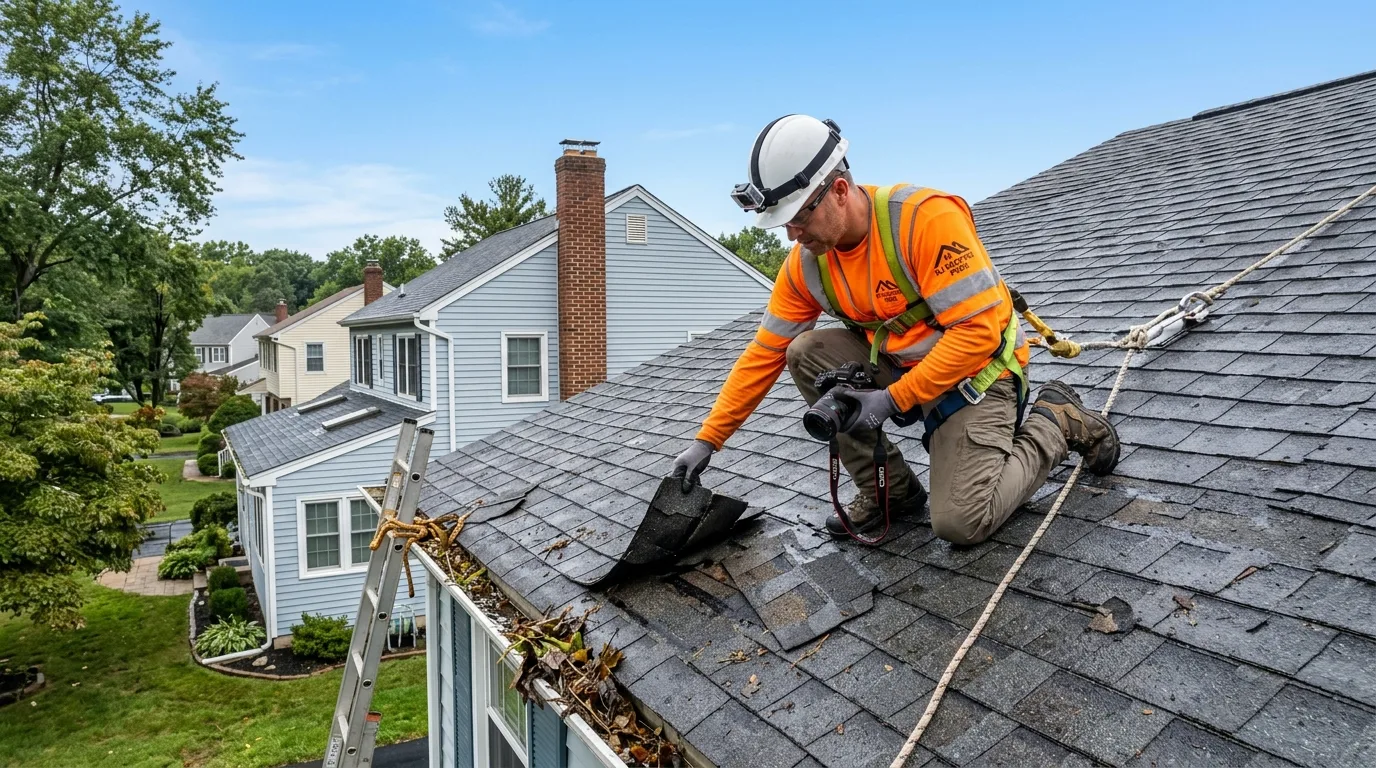
Wind damage does not always mean missing shingles lying on the lawn. In fact, the most common form of wind failure is creased fiberglass mats.
When gale-force winds lift shingle tabs upward, the shingle bends sharply. Even if the tab falls back flat after the storm, the internal fiberglass reinforcing core is fractured. Granules along that crease line rapidly dislodge, leaving the asphalt exposed to rapid solar breakdown and water penetration.
Following severe weather in Somerset County, Bridgewater Roofer provides rapid, forensic documentation including high-resolution date-stamped macro photography and official NOAA weather radar wind-speed records. For step-by-step guidance, see our comprehensive diagnostic checklist on what to check on your roof after a NJ storm.
If your roof has suffered wind uplift or missing shingles, contact our rapid-response team for emergency roof tarping or explore complete storm damage roof restoration. To estimate project costs, try our interactive Somerset County roofing cost calculator.
Need an Expert Assessment on Your Roof?
Talk directly with an experienced Somerset County field tech. 100% Free on-site inspection.
Frequently Asked Questions
Yes, wind damage often shows as lifted tabs, dark horizontal creasing lines across the top of shingles, or missing ridge caps visible with binoculars. If high winds bent a shingle tab upward, the fiberglass mat is fractured even if the shingle did not blow away completely.
When installed with GAF starter strips, roof deck protection, ridge caps, and 4 qualifying accessories, GAF Timberline HDZ shingles feature an industry-exclusive Infinite Wind Speed Warranty with zero maximum wind limitation.
We maintain 24/7 emergency dispatch crews equipped with commercial sandbags, heavy-duty tarps, and strapping to secure storm-damaged roofs across Somerset County within hours of a storm.