Key Takeaways for Homeowners
- Roofers Don’t Shingle Over Panels: You cannot reroof around solar arrays; all panels, inverters, and mounting hardware must be completely uncoupled and stored safely during tear-off.
- Typical R&R Cost: In New Jersey, solar detach and reset services range between $150 and $300 per panel depending on system size, inverter type, and roof steepness.
- Coordination Is Essential: Bridgewater Roofer coordinates seamlessly with certified NABCEP electricians to minimize solar system downtime to 24–48 hours.
- Critical Flashing of Stanchions: Lag screws piercing the roof deck must be protected with raised aluminum flashing plates and high-grade sealants to prevent hidden water entry.
- Check Your Solar Contract: Leased systems (Sunrun, Tesla, Trinity) require written authorization before uncoupling to preserve equipment output guarantees.
The Solar R&R Dilemma in New Jersey
New Jersey has long been a national leader in residential solar energy adoption. Spurred by generous state solar renewable energy credits (SRECs) and utility net metering, tens of thousands of homeowners throughout Somerset County—particularly in Bridgewater, Hillsborough, and Branchburg—installed rooftop photovoltaic arrays between 2008 and 2018.
However, many of those solar arrays were bolted directly onto existing asphalt roofs that were already 10, 12, or 15 years old. Today, those underlying shingles have reached the end of their operational lifespan. Shingles beneath panels suffer from brittle asphalt, hidden pipe collar leaks, and dried adhesive strips.
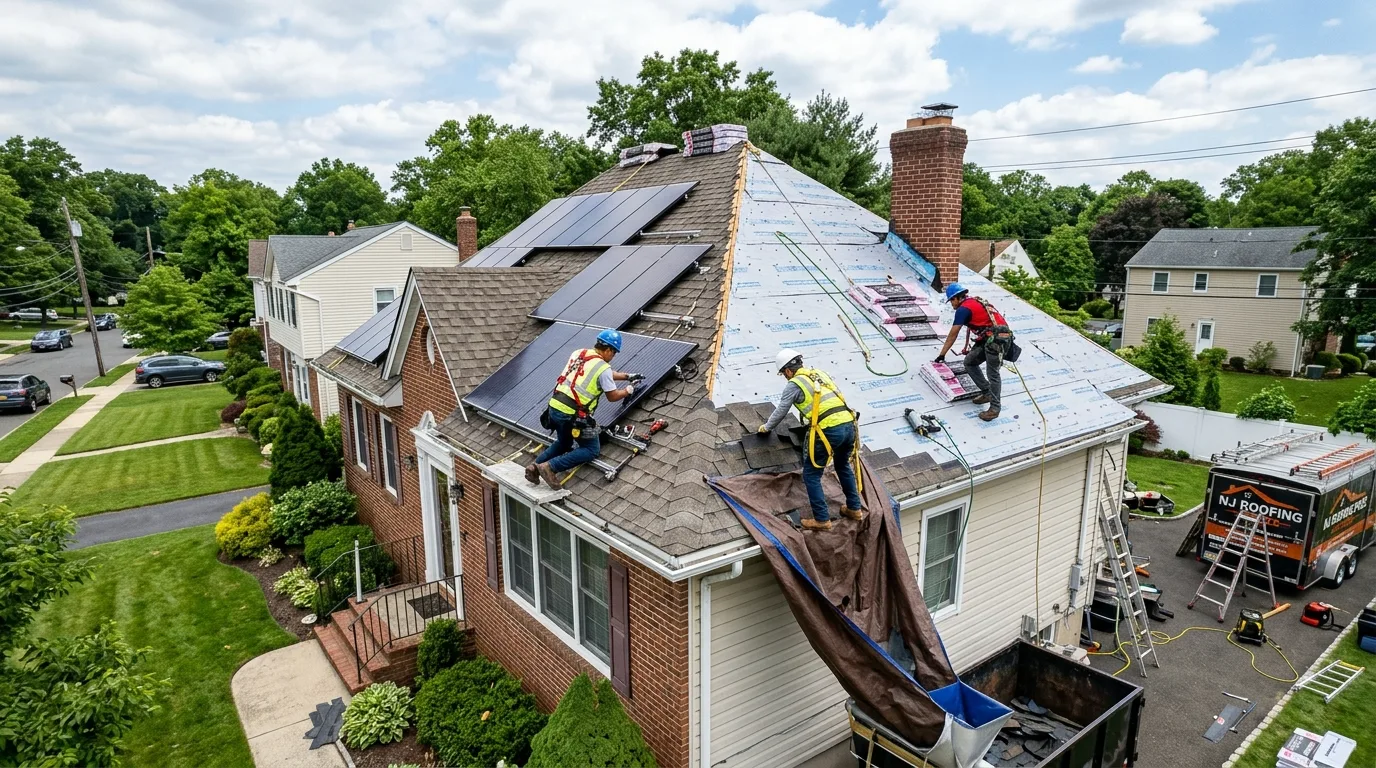
Homeowners are stunned to learn that roofing contractors cannot simply "work around" or "patch beneath" solar panels. Every individual panel, inverter string, and mounting stanchion must be mechanically uncoupled, lowered to the ground, and safely stored before roof tear-off can commence. Executing a seamless Solar Detach & Reset (R&R) requires tight, synchronized coordination between certified NABCEP electricians and master roofing crews. Learn more about full system reroofing on our roof replacement in Bridgewater, NJ service page.
The Step-by-Step Detach & Reset Workflow
At Bridgewater Roofer, we streamline the solar reroofing timeline into four synchronized phases to minimize lost kilowatt generation:
- Electrical De-Energizing & Uncoupling: Certified solar technicians disconnect the AC/DC isolation switches, verify rapid-shutdown compliance, tag high-voltage DC wiring strings, and safely detach panels from aluminum mounting rails.
- Hardware Dismantling & Ground Staging: Rails, conduit pipes, microinverters, and mounting stanchions are extracted. Panels are individually inspected for micro-cracks and safely stored in climate-secure garages or padded ground-level storage racks.
- Complete Tear-Off & Decking Remediation: Our roofing crews strip old shingles down to the bare wood, extract abandoned lag bolts, replace rotten plywood sheets, install ice-and-water barriers across eaves and valleys, and lay down modern architectural shingles.
- Elevated Bracket Re-Mounting & Commissioning: Stanchions are anchored using elevated waterproof flashing tiles, rails are torqued to manufacturer specs, panels are reset, and the inverter system is powered on with utility grid verification.
Decking Remediation: Fixing "Shiner" Lag Bolts and Dry Rot
When our roofing technicians remove solar mounting brackets, we frequently discover severe concealed structural defects created by original solar installers:
1. Missing the Rafters ("Shiners"): Original solar installers worked blindly through existing shingles. In many cases, 3/8-inch lag bolts missed the 1.5-inch wooden rafter framing entirely, piercing only thin 1/2-inch plywood sheathing. Under heavy winter snow loads and wind uplift along the Martinsville and Warren ridges, these unanchored lag bolts strip out of the plywood, creating gaping holes that leak into attics.
2. Trapped Organic Rot: Windblown leaves, pine needles, and dust collect beneath the low clearance of solar panels. Without adequate sunlight and airflow, this organic silt retains rainwater like a sponge, rotting the asphalt shingles and decomposing the underlying plywood sheathing. For diagnostic repair procedures, review our roof flashing and rafter repair manual.
During our detach-and-reset workflow, Bridgewater Roofer cuts out all rotted or compromised sheathing and installs brand-new 5/8-inch CDX exterior plywood sheets, ensuring your new roof has 100% structural stability before solar brackets are re-anchored.
Average Costs per Panel in Somerset County
Solar detach and reset pricing in Central New Jersey is billed on a per-panel basis, covering electrical disconnect, secure storage, elevated re-flashing, and grid re-activation:
| System Size | Panel Count Range | Estimated Detach & Reset Budget | Average Project Timeline |
|---|---|---|---|
| Small Residential System (4–6 kW) | 12 to 16 panels | $2,200 – $3,800 | 1 Day Disconnect / 1 Day Reconnect |
| Medium Suburban System (7–10 kW) | 20 to 28 panels | $3,800 – $5,800 | 1–2 Days Reroof Synchronization |
| Large Executive System (11–16 kW) | 32 to 45 panels | $5,800 – $8,500+ | 2 Days Coordinated Re-Commissioning |
If your roof replacement is covered by homeowners insurance due to hail or storm impact, solar detach and reset costs are fully reimbursable under New Jersey insurance claim guidelines. Check our guide on what to check on your roof after a NJ storm and calculate full project budgets with our Somerset County roofing cost calculator.
Flashing Brackets into New Shingles: Zero Compromise
The most vulnerable penetration on any solar-equipped roof is the lag bolt anchoring the mounting foot through shingles into structural rafters. Historically, budget solar installers applied a dab of silicone caulk under the foot and drove the lag bolt directly through the shingle face—a shortcut that guarantees leaks within 4 to 6 years as silicone shrinks and cracks.
When Bridgewater Roofer installs shingles under a reset solar array, we mandate commercial all-metal elevated flashing stanchions (such as QuickMount PV or IronRidge FlashFoot):
-
Heavy Aluminum Flashing Tiles: Oversized 9x12-inch aluminum flashing plates slip seamlessly beneath upper shingle courses, shedding water naturally down the roof.
-
Elevated Water Barriers: The structural attachment point sits on an elevated raised pedestal, elevating the fastener penetration completely out of the water plane.
-
Dual EPDM Compression O-Rings: Weatherproof rubber seals compress against structural lag bolts, preventing moisture migration even during heavy driving rain.
Critter Guard Mesh: Defending Against Squirrels & Birds
In wooded Somerset County communities such as Basking Ridge, Bedminster, and Martinsville, rooftop solar arrays create an ideal, warm nesting sanctuary for eastern gray squirrels, pigeons, and raccoons.
Rodents routinely gnaw on high-voltage DC wire coatings beneath panels, triggering hazardous electrical arc-fault shutdowns and creating significant fire risks. During the reset phase, our crews install heavy-gauge black PVC-coated steel critter guard mesh fastened securely around the entire perimeter of the solar array with UV-resistant nylon clips. This physical barrier blocks wildlife nesting while maintaining complete airflow beneath panels for peak electrical efficiency.
Leased Solar Systems (Sunrun, Tesla, Trinity) vs. Owned Arrays
Before scheduling your roof replacement, determine whether your solar system is owned or under an active third-party lease or Power Purchase Agreement (PPA):
If You Own Your Solar Panels: You have complete freedom to hire Bridgewater Roofer and our certified electrical partners to uncouple and reset your panels, typically saving $2,000 to $4,000 compared to national solar service departments.
If Your Panels Are Leased (Sunrun, Trinity, Tesla SolarCity): You must notify your leasing provider 60 to 90 days prior to your roof replacement. Most lease agreements mandate that their authorized subcontractors perform the detach and reset to preserve your equipment output warranty. We coordinate our roofing start dates directly with your solar provider's technicians so shingles are installed the moment panels are removed.
If your original solar installer has gone out of business (a common occurrence across New Jersey), our certified team can safely service and re-certify orphaned solar arrays. Schedule a certified roof and solar evaluation or call our team directly at (908) 465-9944.
Need an Expert Assessment on Your Roof?
Talk directly with an experienced Somerset County field tech. 100% Free on-site inspection.
Frequently Asked Questions
Yes, we provide end-to-end coordinated solar roof replacements throughout Somerset County. We coordinate the certified electrical uncoupling, safe on-site panel storage, complete architectural shingle installation, bracket re-flashing, and system re-commissioning under a single managed schedule.
No, provided the disconnect and reset is executed by certified technicians using code-approved mounting and torque specifications. If your system is under an active solar lease or PPA, we follow the provider’s technical protocol to keep your production guarantee 100% active.
Typically only 24 to 48 hours. Panels are disconnected on Day 1 morning, the roof tear-off and replacement is executed that same day, and panels are remounted and tested by the afternoon of Day 2.